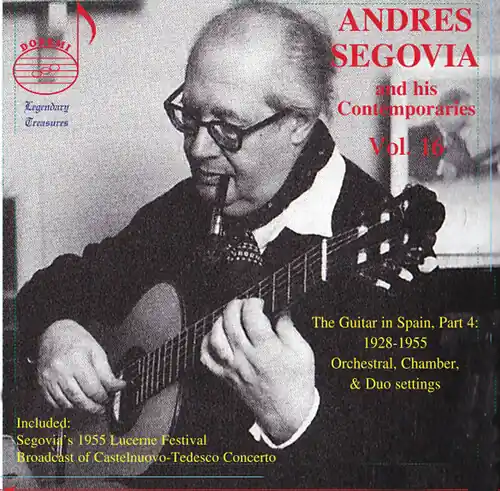
Segovia & His Contemporaries Vol. 16 Place Order
Original price was: $18.99.$9.49Current price is: $9.49.
DISC: 1
| 1. Concerto No. 1 in D, Op. 99~Allegretto |
| 2. Concerto No. 1 in D, Op. 99~Andantino alla romanza |
| 3. Concerto No. 1 in D, Op. 99~Ritmico e cavalleresco |
| 4. Donna Diana~Menuetto for Flute, Viola, and Guitar |
| 5. Guitar Quintet in E, No. 7, Op. 11, G. 451~Menuett |
| 6. Guitar Quintet in E, No. 7, Op. 11, G. 451~Allegretto |
| 7. Danzas Fantasticas No. 3, Op. 22: Orgia |
| 8. Allemande |
| 9. Tres Caprichos para Vihuelas |
| 10. Fiesta Mora em Tanger (Album de Viaje, No. 5) |
| 11. Capricho Arabe |
| 12. Suite Española, Op. 47~Sevilla |
| 13. Folias – Canarias |
| 14. Work(s)~Milonga No. 4 ; Gato |
| 15. Vidalita |
| 16. So de Pastera |
| 17. Festa de Sant Antoni |
| 18. Sinfonia No. 39~Minueto |
| 19. Romanza No. 2 |
Powered by Broadtime Tuneportals
More Info:
Segovia and His Contemporaries Volume 16 – The Guitar in Spain, Part 4: 1928-1955:This disc highlights the classical guitar in orchestral, chamber, and duet settings. It opens with the live broadcast of the Castelnuovo-Tedesco Concerto No. 1, made on August 17, 1955 by Segovia at the Lucerne Festival. Chamber music is represented by two 1932 recordings made by Luise Walker, Miguel Llobet’s student, of works by Carl Maria von Weber and Luigi Boccherini; and of particular interest are 1928 recordings by the world-renowned Cuarteto Aguilar, comprised of four lauds (types of Spanish lute), of works by Joaquin Turina and Renaissance composers Gabriel Mena and William Croft. The Guitar in Duo appears in rare performances by four pairings: the Canarian musicians Victor Doreste and Ignacio Rodriguez (1930), who perform Capricho Arabe, Sevilla and a Folias Canarias; the Argentinean duo of Antonio Sinopoli and his daughter Nelida (1932), who play a milonga and vidalita penned by the father; the Mallorcan Bartolome Calatayud, a student of Tarrega, and the Catalan Graciano Tarrago (1936), who assay a popular Mallorcan dance So de pastera and Joan Maria Thomas’ Festa de Sant Antoni; and lastly another Argentinean duo, Consuelo Mallo Lopez and Maria Herminia Antola (1937), who conclude with Mozart’s ‘Minueto de la Sinfonia No. 39’ and Galluzzo’s Romanza No. 2.
Related products
-
Sale!

Plays the Legacy of Duke Ellington Super Sale
Original price was: $12.99.$6.50Current price is: $6.50. Add to cart -
Sale!

Best Seller Blue Boat / Various
Original price was: $19.99.$9.99Current price is: $9.99. Add to cart -
Sale!

Place Order Sex Packets
Original price was: $39.97.$19.98Current price is: $19.98. Add to cart -
Sale!

Don'T Let Your Deal Go Down Reduced Price
Original price was: $12.97.$6.49Current price is: $6.49. Add to cart